 Blog
The hub-and-spoke laboratory: what the hub asks of your instrument
Aimasoft Team
October 28, 2026
A glucose result is produced in a primary care clinic at the edge of a region. The person who ran it is not a laboratory professional. The device sits in a consulting room, far from the central laboratory.
Yet in a hub-and-spoke laboratory model, it is the central laboratory that answers for that result. Before letting devices like this into its network, a laboratory can set conditions for their use. For the manufacturer, those conditions become questions about the product.
Two movements form one model
Consolidation and point-of-care testing (POCT) can look like opposite trends. One pulls testing into large central facilities, the other moves it closer to patients.
In European clinical microbiology, Vandenberg et al. (Frontiers in Medicine, 2018) described how consolidation produced a combined model. Large central laboratories run most tests on high-throughput platforms and are connected to distal sites that handle urgent analyses near the point of care.
A 2025 study from Policlinico Gemelli IRCCS in Rome (Moretti et al., Diagnostics) describes a similar structure in clinical chemistry, as a hub-and-spoke model of clinical governance. The central laboratory is the hub, and it provides oversight, quality assurance and data integration for multiple decentralised testing points.
In both accounts, centralisation and decentralised testing are parts of a single design.
Responsibility stays with the central laboratory
What this model changes is the distance between where a result is produced and who answers for it. The hub is responsible for results obtained on instruments it does not physically manage, often in settings outside its direct control.
Standards follow the same line. For laboratories accredited to ISO 15189:2022, the POCT requirements previously set out in ISO 22870 are now part of the standard, and laboratory-supported testing falls within the laboratory's own quality management system.
The Gemelli team evaluated a multi-analyte POCT platform before deploying it into their primary care network. The conditions they set are a useful indication of what a hub may expect:
- performance varied enough between analytes that each assay needed its own assessment
- results obtained under controlled conditions may not hold in routine use
- operators need centrally managed training and certification
- connecting devices to laboratory and health record systems is, in the authors' words, paramount for real-time quality monitoring
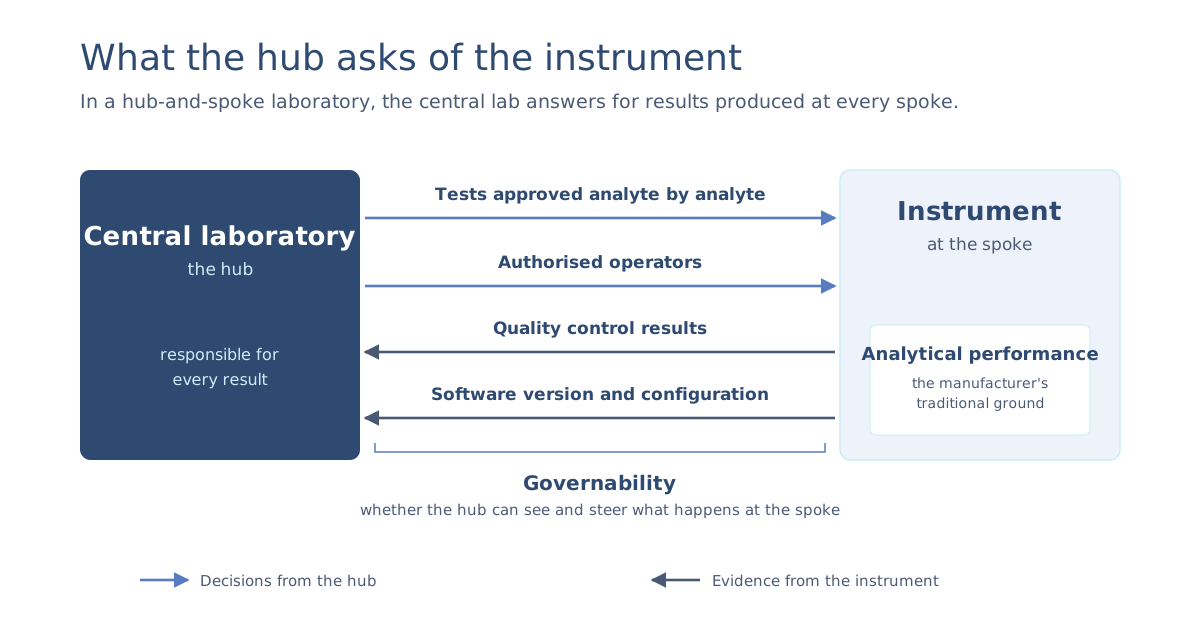
The first two are about analytical performance, the manufacturer's traditional ground. The others, and the way analytical performance is followed once devices are in use, are about something else: whether the central laboratory can see and steer what happens at the spoke.
Governance conditions become product requirements
For a manufacturer whose device is heading into a hub-and-spoke network, each condition can translate into something the product, or the software around it, has to support.
Tests are approved analyte by analyte
In the Gemelli evaluation, some analytes were judged suitable for decentralised use and others were not. The device, or the software managing it, needs a way to reflect that decision.
Operators are authorised centrally
If training and certification are managed by the hub, the hub may want that status enforced where testing happens, not only recorded in a training file.
Quality control results travel to the hub
Real-time quality monitoring depends on QC results reaching the hub as reliably as patient results do.
Installed instruments need a traceable configuration
If performance is followed over time, as the Gemelli authors recommend, knowing which software version and configuration each instrument runs becomes a useful context for the quality record. Keeping that consistent across many sites also becomes an operational question.
Devices built for decentralised use often cover these points through dedicated data management software, which then has to be integrated with the laboratory's own systems, a question of architecture more than of standards. The useful check is whether a given product does, and how completely.
Customers set the conditions
The hub-and-spoke model is organised by healthcare providers and their laboratories, and the central laboratory defines the conditions. Whatever the instrument does not support is left to other software, to procedures, or to people at each site.
A practical step is to check the current product against these points, before a customer does.
Instrument interfaces, device connectivity and remote software updates are among the services Aimasoft provides to MedTech companies, and each of them bears on at least one of the points above.
Sources
- Moretti G., Alcaro F.D., Colacicco L., Urbani A. (2025). Comprehensive Evaluation of a Point-of-Care Testing Platform for Decentralized Primary Healthcare: Ensuring Analytical Quality Through Central Laboratory Oversight. Diagnostics, 15(23), 2977. https://doi.org/10.3390/diagnostics15232977
- Vandenberg O., Kozlakidis Z., Schrenzel J., Struelens M.J., Breuer J. (2018). Control of Infectious Diseases in the Era of European Clinical Microbiology Laboratory Consolidation. Frontiers in Medicine, 5:15. https://doi.org/10.3389/fmed.2018.00015
- Plebani M. et al. (2025). Point-of-care testing: state-of-the art and perspectives. Clinical Chemistry and Laboratory Medicine, 63(1), 35–51. https://doi.org/10.1515/cclm-2024-0675
- UKAS Technical Bulletin, Publication of ISO 15189:2022. https://www.ukas.com/resources/technical-bulletins/publication-of-iso-151892022/

